AI Visibility Audits: How to Measure Brand Presence in AI Search
An AI visibility audit measures how often and how accurately your brand is cited in generative AI responses (like ChatGPT, Perplexity, and Gemini). Unlike traditional SEO, which tracks clicks, AI search optimization tracks citations, sentiment accuracy, and AI Share of Voice. To close the AI visibility gap, brands must audit their structured data, ensure content clarity for LLM extraction, and monitor “dark traffic” attribution.
Search isn’t just changing. It’s completely breaking the old rules.
For the last decade, digital visibility meant one thing: Ranking on page 1 of Google and getting the click.
But today? A massive chunk of your target audience isn’t clicking links anymore. They are asking ChatGPT, Perplexity, or Claude a question and getting a synthesized answer right on the screen.
Here’s the scary part:
You might rank #1 in traditional search results but completely vanish inside the AI answers your buyers actually read.
Closing this gap requires a massive shift from traditional SEO to Generative Engine Optimization (GEO).
In this guide, I’ll show you exactly how top brands conduct AI visibility audits, track hidden AI citations, and build unshakeable authority in generative search.
What exactly is an AI visibility audit?
An AI visibility audit is a systematic evaluation of how frequently, accurately, and prominently a brand is cited and represented in responses generated by Large Language Models (LLMs) like ChatGPT, Gemini, and Perplexity.
Most marketers think AI just “scrapes” the web. It doesn’t. It synthesizes.
When you run an AI visibility audit using platforms like, you aren’t checking keyword rankings. You are tracking:
- Citation Frequency: How often the AI names your brand as a source.
- Sentiment Accuracy: Is the AI describing your product correctly, or hallucinating outdated pricing?
- Competitor Share of Voice: Are your rivals dominating the AI narrative while you sit on the sidelines?
Why are traditional SEO metrics failing in AI search?
Traditional SEO metrics rely on trackable clicks and referral traffic, but AI search environments generate synthesized answers that keep users on the platform, resulting in untracked “dark traffic” and hidden brand mentions.
Think about the old search journey: Search → Scan SERPs → Click a blue link → Read the page.
Now look at the AI journey: Ask a conversational question → Read the synthesized answer → Done.
But here’s the kicker: Users never visit the underlying sources.
This means your Google Analytics (GA4) is flying blind. Traffic from AI tools frequently strips referral data, dumping it straight into the “Direct” bucket. We call this dark traffic.
So, how do you know if AI is actually driving business? You look for secondary signals:
- Spikes in branded search queries.
- Sudden surges in direct traffic to deep, bottom-of-funnel informational pages.
- Increases in demo requests immediately following major AI model updates.
How do you actually run an AI visibility audit?
To run an AI visibility audit, you must map core conversational queries, prompt multiple LLMs simultaneously, document brand citations and sentiment, and benchmark your AI Share of Voice against competitors.
Here is the exact 5-step framework we use at Semrush to audit AI presence:
Step 1: Map the “Zero-Click” Queries Identify the exact questions your buyers ask. Don’t use keywords. Use full conversational prompts. (e.g., “What is the best enterprise CRM for healthcare in 2026?”)
Step 2: Prompt Across the Big Four Run those prompts through ChatGPT, Perplexity, Claude, and Gemini. AI models have different training weights and biases. You need a holistic view.
Step 3: Code the Mentions and Sentiment Did the AI mention you? Was it a direct citation (a linked source) or an implicit mention? More importantly, was the information accurate? LLMs love to hallucinate outdated feature sets.
Step 4: Reverse-Engineer the Citations Look at the sources the AI did cite. Are they industry publications? Niche blogs? Your competitors’ guest posts? This tells you exactly where you need to build your off-page authority.
Step 5: Benchmark the Competition Calculate your AI Share of Voice. If your competitor is cited in 8 out of 10 prompts and you are cited in 2, you have a massive authority deficit to close.
What makes a brand get cited by AI models?
AI models cite brands that offer high entity clarity through structured data (Schema), direct and extractable answer-first content, and flawless technical accessibility for AI web crawlers.
In the GEO world, citations are the new backlinks.
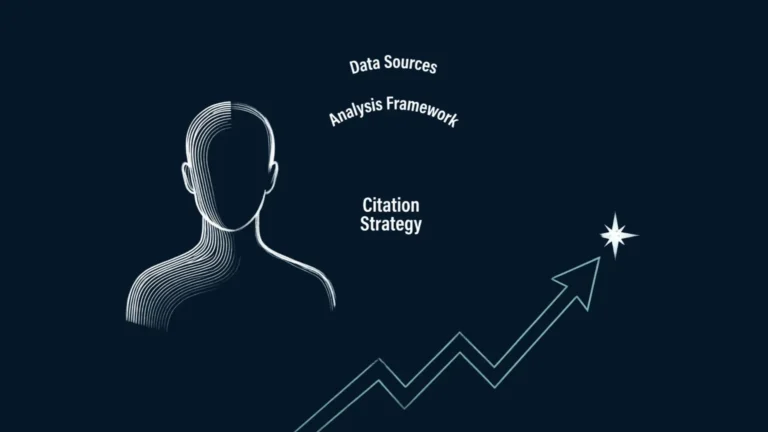
But you can’t just “build links” to get cited. Let me explain. You need the Semrush 3-Pillar Framework:
- Structured Data (Entity Clarity): LLMs don’t read text; they read relationships. If your Schema markup doesn’t clearly define your brand, products, and pricing as distinct entities, the AI won’t trust you enough to cite you.
- Content Clarity (Extractability): AI prefers “Answer-First” content. Stop burying the lede. Use clear H2s, bulleted lists, and concise summary paragraphs that an LLM can easily scrape and synthesize.
- Technical Accessibility: If your site blocks AI crawlers (like GPTBot or PerplexityBot) via
robots.txt, or if your Core Web Vitals are in the toilet, the AI simply won’t index you. You can’t be cited if you can’t be crawled.
How do you track AI attribution and prove ROI?
You track AI attribution by correlating AI citation spikes with branded search volume increases, monitoring dark traffic surges on specific landing pages, and using dedicated GEO measurement platforms to track AI Share of Voice over time.
Proving ROI in the AI era is tough. But it’s not impossible.
Why continuous monitoring? Because LLMs update their weights constantly. A citation you earned today might vanish in tomorrow’s model update.
By tracking these metrics monthly, you can directly correlate your GEO content efforts with increases in branded search volume and high-intent direct traffic.
The Bottom Line
Search is no longer a list of blue links. It’s a synthesized conversation.
If your brand isn’t part of the AI’s answer, you are practically invisible to the modern buyer. Metrics like Citation Frequency, AI Share of Voice, and Sentiment Accuracy are your new KPIs.
Frequently Asked Questions
What is an AI visibility audit?
An AI visibility audit evaluates how frequently, accurately, and prominently a brand is cited and represented in responses generated by Large Language Models (LLMs) like ChatGPT, Gemini, and Perplexity.
How do companies audit AI search visibility?
Organizations map core buyer queries, prompt multiple LLMs simultaneously, document brand mentions and sentiment, and benchmark their AI Share of Voice against direct competitors.
Why are AI citations important?
In generative search, citations act as the modern equivalent of backlinks. They signal to AI models that a source is authoritative and reliable, directly increasing the brand’s visibility and trust in synthesized answers.